To get the latest information posted by the USGS Hawaiian Volcano Observatory (HVO), you can visit their Kilauea Status Reports, which is updated daily.
Here is their latest post, which updates the status of the flow running thru Royal Gardens:
Tuesday, December 20, 2011 9:12 AM HST
Activity Summary for past 24 hours: The West Ka`ili`ili ocean entry may be intermittently active fed by flows from Pu`u `O`o through the abandoned Royal Gardens subdivision and expanding across the coastal plain. Glow could be seen from sources within Pu`u `O`o crater. the summit lava lake level was variable. Seismic tremor levels were low and gas emissions were elevated.
Viewing Summary:East rift zone flow field – Active lava flows are within the closed-access Kahauale’a Natural Area Reserve and private property within the abandoned Royal Gardens subdivision and can only be viewed from the air and from the County Viewing Area at Kalapana. Pu`u `O`o Cone, the West Ka`ili`ili lava ocean entry, and Kilauea Crater – Pu`u `O`o cone, the lava ocean entry, and Kilauea Crater are within Hawai`i Volcanoes National Park; access and viewing information can be found at http://www.nps.gov/havo/planyourvisit/lava2.htm.
Photos of lava entering the ocean, taken on December 13, 2011
There are some great pictures posted at their website, follow the link above.
Small streams of lava cascading over the sea cliff, and entering the ocean
The current lava flow, coming down the pali and traversing the coastal plain, reached the ocean late last week. The ocean entry point is within the National Park, near its eastern border. Today, numerous small streams of lava were cascading over the sea cliff, and lava entering the water was starting to build a small delta.
This photograph shows two channels of lava coming over the sea cliff, reaching the new lava delta.
Lava continues to flow through the former Royal Gardens subdivision as it makes it way to the coastal plain and entry into the ocean. This is the first such activity in the area since March of this year. It is possible to catch sight of part of this activity from the public viewing area located at Kalapana. This viewing area is located outside of the Hawaii Volcanoes National Park and is maintained by Hawaii County.
This pic, taken on December 2, 2011, gives a great view of the flow going thru Royal Gardens subdivision.
The flow is following the west margin of lava flows emplaced in February 2010, which brings the current flow close to the last occupied residence (orange structure in center of photo) in Royal Gardens.
Tea was first introduced to Hawaii around 1887. Since then, unsuccessful attempts to commercialize Hawaii grown tea production on Kauai and in the Kona region of the island of Hawaii were attributed to the high cost of production in Hawaii compared to the lower costs in other tea producing areas. This is a recurring problem that faces most commercial crop production in Hawaii. In the late 1980s, some of the sugar firms tried to establish tea plantations to replace sugar cane, but these projects proved to be unsuccessful and were terminated.
And, once again, the University of Hawaii, College of Tropical Agriculture and Human Resources, is involved in research into finding the right plant variety and locations for successful Hawaii grown tea planting. Partnering with their efforts are the Tropical Plant Genetic Resource Management Unit, U.S. Department of Agriculture, Agricultural Research Service, Pacific Basin Agricultural Research Center in Hilo.
Between 1999 and 2001, half-acre plantings were established at each of three locations on the island of Hawaii in Waiakea (600 ft elevation), Mealani (2800 ft), and Volcano (4000 ft). Preliminary observations of these research and demonstration efforts suggest the following:
Tea grows very well at Mealani (2800′) and Volcano (4000) and relatively slower at Waiakea (600′).
Most cultivars are ready for harvest in about 18–20 months after planting.
Green, oolong, and modified green teas processed from tea leaves harvested at Mealani and Volcano are of excellent quality.
Clonal tea plants are recommended over seedlings for their uniform growth, allowing the vegetative cycles to be more readily synchronized for mechanical harvesting.
The pest and disease problems of tea are relatively mild at all three locations and can be readily managed by agronomic practices such as pruning and fertilizer management.
Some of the pests are spider mites, aphids, and leaf rollers. No insecticides or fungicides were applied at any of the three field locations for over three years.
For more detailed and expanded information on this research on Hawaii grown tea.
Hawaii Grown Tea – A Cottage Industry Established
Fast forward to 2011 and 12 years of research and development has established a fledgling cottage industry of Hawaii grown tea. There are now several tea growers on the Big Island of Hawaii. The leaders in this effort, who have been involved during the entire 12-year period, are a husband and wife team of Chiu Leong and Eva Lee, of Tea Hawaii & Company.
They have partnered with three additional growers; John Cross, Sen Woo Fang, and Mike Riley. Together, they market four distinct varieties of Hawaii grown tea:
Home grown garden estate. Tea growers Chiu Leong and Eva Lee of Volcano Village at 4000 feet elevation. Grown in the rainforest of Kilauea volcano under a canopy of native Ohia trees and Hapu’u ferns. Harvested by plucking the top bud and two leaves. The leaves are long, loose and downy and brew into rich clear golden infusion. The flavor is floral and sweet, deeply satisfying and comforting. Truly the first shade grown forest tea of Hawaii.
Hilo Tea Garden tea estate grower Fang Sen Woo of Mountain View at 2000-foot elevation surrounded by tropical flowers. He produces Ola’a Green tea. This tea is a pan fired green tea that is exotic in aroma and pure in flavor. Steeped into a pale golden green infusion with a lingering fresh taste.
Volcano Tea Garden tea estate grower Mike Riley of Volcano Mauna Loa Estates at 3600-foot elevation. His product is named Mauka Oolong. It is flinty, crisp, smooth and cooling, with mild tropical notes of green papaya and honey that add to the complexity of this enticing tea.
Johnny’s Garden tea estate grower John Cross of Hakalau at 900-foot elevation. Makai to face towards the sea is a black tea that is handcrafted with both sinensis and assamica leaves that steep into a crystalline amber infusion. This tea’s flavor profile is smooth and refined with no astringency or bitterness even when steep for long periods. A crisp body that yields delicate notes of caramel, barley malt with hints of chocolate and a slight taste of roasted sweet potato.
Hawaii continues to diversify with more and more premium products that take advantage of the variety of conditions found in Hawaii. From sea level to altitudes exceeding 10,000′, from arid to lush rain-forest conditions, and with rich volcanic soil, opportunities will continue to expand for those venturesome enough to pioneer new crops. The Big Island of Hawaii is also the only place where all three major infusion beverages are grown; Hawaii grown coffee, Hawaii grown cacao (chocolate) and Hawaii grown tea.
Hawaii grown tea is just another example of the premiere products that Hawaii continues to bring to us.
All my life, I have been told that Hawaii’s volcanoes are of the peaceful type. They produce breath-taking fountains of lava and flow to the ocean via lava tubes or awe inspiring, cascading rivers of super heated rock towards the sea. Now, I’ve learned that this is not the case.
I just read a report from the annual meeting of the American Geophysical Union, stating that Kilauea actually has a history of prolonged periods of explosive eruptions! As a matter of fact, there are longer periods of explosive eruptions than peaceful interludes, such as Hawaii has experienced for the last couple of hundred years.
They also report that the explosive eruptions could resume at any time because they have no way of predicting any sort of timetable. From 500 to 200 years ago, it was primarily the explosive type of volcanic activity that marked Kilauea’s eruptions.
To quote from an article written by David Perlman and published on SFGate.com (San Francisco Chronicle):
“Eruptions and flows
“The geologic record shows that Kilauea’s activity has been marked by a period dominated by frequent lava flows from about 2,500 to 2,200 years ago, followed by a long period of explosive eruptions that continued for about the next 1,200 years; then another 500 years of lava flows, followed by about 300 years of eruptions, and then by more lava flows that continue today.
More than 100 radiocarbon observations, based on charcoal from the mountain’s burned vegetation, have established the dates, Swanson said.” [Donald Swanson of the U.S. Geological Survey and director of the Hawaii Volcano Observatory.]
He went on to say,
The lava flows are building up the volcano’s summit now, he said, and each period of violent eruptions creates and deepens the volcano’s circular crater, called the caldera. When even a small eruption is about to occur, he said, the bottom of the caldera sinks slightly. So its level is recorded daily as a possible sign that an eruption is due.
“The good news is that we are currently in a period of frequent lava flows, and the hazard of explosive eruptions is small,” Swanson said. “The bad news is that we don’t know when the next period of deep caldera and explosive eruptions will start. We know too little to estimate recurrence intervals.”
So, I guess your perception of Kilauea and the volcanoes in Hawaii has been changed along with my own. It won’t take away from the magnificence of watching Madam Pele [Goddess of the Volcano] at work, but it does give me pause and gratitude for not having to worry about the explosive eruptions that have occurred in the past. That could change, of course, but I’d like to believe that this peaceful phase will last for at least another couple of hundred years!
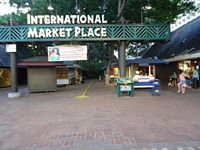
While the many vendor stalls and wagons may still sit in their usual spots, the vendors and merchandise that once made the International Marketplace a favorite of many visitors and locals alike – are gone. December 31, 2013 marked the last day for this iconic location and while there are a few storefronts still open along Kalakaua Avenue, they too, will close their doors for the final time at the end of January.
For those who may not have been aware, the Queen Emma Foundation, owners of the land, has opted to replace the International Marketplace with an upscale mall, anchored by Saks. Viewed from a strictly economic view, this decision makes sense in terms of the increase in dollars that will be generated which can be put to use towards the Queen Medical Center’s west facility. You can read more about this controversial decision here in an earlier post.
My kids used to always look forward to spending a couple of hours navigating the carts and stores, looking for hidden bargains away from the glitz and glamor of Waikiki. I think that was the attraction of the International Marketplace for the majority of people. With its demise, we lose another uniquely Hawaiian experience.
There may even be a small number of people who would say that the removal of the aged International Marketplace is a good thing from an aesthetics point of view. And, yes, many of the structures were long over do to be replaced, but the true value of this iconic shopping area is probably more nostalgic than practical. It represents a simpler time before Waikiki became a concrete, metal, and glass jungle, when the Pink Castle (aka Royal Hawaiian Hotel) was a visible landmark…from the street, not just the ocean.
If its any consolation, it is my understanding that both the Monkeypod tree and the International Marketplace sign will be spared and will be incorporated into the new mall landscaping. I wonder it they’ll also keep the koi pond?
International Marketplace Sign
I guess this is more of a personal loss for many of us who will miss this Waikiki landmark, but I do believe that more people will miss this more laid-back venue than those who are eagerly anticipating the arrival of Saks. The cost of progress seems disproportionately high, but economics rule. It just seems Waikiki has turned into just another shopping mecca, similar to many of those found throughout the US…except, of course, for the tropical setting.
I guess we should be happy that the Pink Palace and the Hilton Rainbow Tower still stand as Waikiki landmarks. Hopefully, they will remain recognizable for the foreseeable future.
Aloha oi International Marketplace! You can look for the new mall and Saks sometime in 2015.
Update: The new projected opening date for the new upscale mall is spring 2016.
USAirways announced new higher fees for overweight luggage/baggage for anyone who purchased tickets after February 1, 2011 or travel after March 1st. For travel within the US/Canada/Latin America/Caribbean, you will be charged $90 for bags weighing 51 to 70 lbs each way. For bags weighing between 71 and 100 lbs, the fee is $175 each way. Overseas travelers face even higher fees.
These fees are in addition to the standard checked baggage fees of $25 for your first piece, $35 for your second piece, and $125 for your 3rd thru 9th checked bags. Prior to this change, your 3rd thru 9th bags would have cost an extra $100/bag. Again, these are fees for travel within the US/Canada/Latin America/Caribbean.
The over-sized bag fee is also raised to $175 per piece, each way.
There are exceptions to the checked baggage fees, including active duty military personnel and frequent fliers who have reached silver, gold, and higher status. For more information, check out their Frequently Asked Questions section of the USAirways website.
While USAirways is not a major carrier of traffic to Hawaii, the question is will other airlines increase their fees as well? If history shows us anything, its that they will see how the public reacts…then follow suit.
By the way, do you remember the “fuel surcharge”? As oil prices continue their rapid increases and with talk of gas hitting $5.00/gallon by the end of 2012, I would not be surprised to see that rear its ugly head once again. What do you think?
It is estimated that protection of these endangered animals has allowed the number of wintering humpbacks in Hawaiian waters to increase from an estimated 1000 back in 1978 to an estimated to 10-12,000 currently. That’s about 50-60% of the estimated total North Pacific Humpback count of 20,000.
The Hawaiian Islands Humpback Whale National Marine Sanctuary is still looking for a few more volunteers to participate in a whale count on Oahu, the Big Island and Kauai.
The annual count is held at numerous locations from 8 a.m. to 12:15 p.m. on three Saturdays:
Jan. 26, Feb. 23 and March 30, 2013
Volunteers may register online at www.sanctuaryoceancount.org for locations on Oahu, Kauai, and the Big Island. Check to see if the location you’re interested in still has openings…many do.
Whether you’re an island resident or a tourist looking for something special to do while on vacation, you can be a big help in the conservation efforts of these gentle giants of the sea. Mahalo!
UPDATE 1/22/13): Great news! All slots for volunteer counters have been filled for this year’s whale count.
Tickets for the 2013 Merrie Monarch Festival, being held March 31st to April 6th, in Hilo, are available via the mail. You can apply for a maximum of 2 tickets to the 3-days of competition, Thurs (Apr 4th), Fri (Apr 5th), and Sat (Apr 6th). Tickets costs depend upon seat selection. You can purchase tickets to the Miss Aloha Hula competition held on Thursday night, or you can purchase 2-day tickets for the group competitions held on Friday and Saturday nights.
Most activities during the Festival week are free to the public; however this year, tickets are needed to attend the Wednesday Hōʻike and the three-day hula competition. This year tickets to the Wednesday night Ho’ike will cost $5.00 each and you can apply for up to 4 tickets. The Merrie Monarch Festival Committee is coordinating a special Ho’ike to salute the 50th Celebration of the Merrie Monarch Festival. We have invited some of the original dancers, first Kāne winners and special guests to grace the stage. You can find the application for the Ho’ike tickets by clicking the link above.
All applications must be postmarked no earlier than December 26th (yesterday), so you still have a good chance to get tickets if you act quickly. Tickets for the Merrie Monarch hula competition sell out quickly, so if you want to attend, I would strongly suggest you print out, complete and mail your application today!
When people think of fishing in Hawaii, thoughts immediately go to giant Marlin or Mahimahi and while there is excellent deep sea fishing to be found on all the islands, not everyone can afford to spend the $150-300/day that chartering a boat will cost (per person). Adding insult to injury, in Hawaii, unlike many other places, the “catch” belongs to the boat, not the angler! So, if you had your sights set on Mahimahi steaks for dinner, the nearest restaurant or fish market would better serve you. So, check with your charter captain first to see what arrangements can be made on any fish you may catch.
Shore Fishing in Hawaii
This post, however, is on shore fishing in Hawaii. Many locals are avid shore fishermen and women and pursue their two most favorite fish, the Papio or Ulua (Jack or Giant Trevally) and the O’io (bonefish). Of course, there are also times and/or seasons for pursuing other island favorites such as the Aholehole, Kumu, Moano, Oama or Weke, Halalu or Akule, Moi, and whatever else may be running. There are even those who venture out at night, “torching” for “Tako” (aka octopus), both as for bait or to eat. (“Torching” in Hawaii can be compared to “gigging” on the mainland, where flounder are pursued in the shallows in a similar fashion except not from the comfort of a boat.)
Hawaii is the only coastal state left that does not require a salt-water recreational fishing license, at least not yet. That does not mean fishing in Hawaii does not involve a full set of rules and regulations covering what, when, where, and even how you can catch your fish. For example, some of the locals may not be aware of the 10″ minimum size requirement for Papio, or the 5″ minimum size for Aholehole, or the 11″ minimum size and closed seasons for Moi, as is evident by some of the youtube videos being posted.
More than just about anywhere else, fishing in Hawaii is a social gathering. As much or more attention is given to the “kaukau”, or food that will be brought than to the actual fishing. Lets just say, it would be fair to say that going fishing in Hawaii often involves packing the hibachi or full blown gas bbq grill along with the fishing gear. It can be as fully involved as tail-gating at your favorite football game.
Ulua or GT
Ulua, or Giant Trevally, is probably the #1 sought after fish and devotees join clubs and tournaments in pursuit of 100+ pound fish, a true trophy of a lifetime. On the eastern seaboard from the mid-Atlantic states into the Gulf region, “jacks” are considered trash fish! Nobody eats them, very few pursue them, and there are certainly no clubs or tournaments focused on them. For them to relate, they need to think in terms of red drum and striped bass and the passion that incites to appreciate the status of Uluas in Hawaii.
Their tackle is as specialized as it gets. King Mackerel fishing from an east coast pier is as close to GT fishing in Hawaii as it gets. It often involves the same anchor-line pole with a slide-bait technique, however, in Hawaii they don’t use a separate anchor line. They simply throw out and anchor their lines, then slide down the baited hooks, all on the same pole.
Where the real differences come in is, I have not heard of any King fisherman being pulled to his death off of the end of a pier by large waves, whereas this is unfortunately, a fairly regular occurrence with ulua fishing.
Safety is just one of the reasons for ulua fishing clubs and/or groups existing. Another reason for such club outings is it is a team effort landing one of these giant fish in the kind of terrain ulua fishing often involves. Fishing from a sandy beach is the exception, rather than the norm for Ulua fishing. Rocky shorelines, usually involving cliffs of 20′ or more, are more commonly the battleground for these pursuits.
And, if that’s not enough, these 100+ lb. fish are typically caught at night.
The YouTube ID of 9OXPP_cHKbo#! is invalid.
This video shows the team work involved with landing an Ulua from a typical rocky shore.
Of course, the biggest reason shore fishing in Hawaii is, as I mentioned before, a social gathering and eating event. Just as important as what bait will be used is what food will be taken and prepared. Most Ulua outings involve an overnight stay, so food is required. But, even if its not going to be an overnight stay, there will be food! Shore fishing in Hawaii, combines the best of surf fishing and tail-gating and if actual fish are caught, all the better!
However, for every enthusiast that pursues a 100-pound ulua, there are dozens of fishermen and women who are just as happy pursuing the under 10-lb Papio (Jack Crevalle). They are commonly found in virtually all the Hawaiian waters and eagerly attack both bait and artificial lures presented to them. Their popularity is such that unlike any other state, there are size and catch limits for these fish.
While commonly eaten in Hawaii, catch & release fishing is becoming more common. This practice has been helped along not only by the locals awareness for conservation of this resource, but also due to the Ciguatera toxin that infects many of the ulua found in Hawaii. Eating an infected fish can cause mild to severe symptoms include gastrointestinal and neurological effects. That does not take away anything from the sport of catching these great fighters.
O’io or Bonefish Fishing in Hawaii
Fly-fishing for O’io (Bonefish), in Hawaii has only become a “sport” in the last 30-years or so. The majority of O’io are caught while bottom-fishing using either shrimp or ika (squid) as bait. And, again unlike Florida fishermen who treat Bonefish as a strictly catch and release fish, in Hawaii, the O’io is excellent for use in making fish cake, popular with the locals. Catch & Release fishing for O’io is also becoming more and more commonplace, especially with the fly fishermen, but there are many who still pursue them as a food source.
So, the next time you plan a trip to Hawaii, maybe you should check into the local fishing scene and see what’s “running” and see if you can’t get in a little shore fishing time and not have to budget as much as that off-shore fishing excursion would cost. I will say that there is a near-shore fishing charter that goes just outside of Waikiki and pursues many of these same fish, aimed at the younger family members and is more affordable than a big game charter would be. Fishing in Hawaii is not limited to chasing 800 lb. Marlin!
Commonly Caught Fish and Their Restrictions
This is by no means an all-inclusive listing, but simply the more commonly shore, hook-and-line caught fish you are likely to catch. For a more information on regulated areas and species, you can go to the state website: http://hawaii.gov/dlnr/dar/regulations.html and for the current list of limit and size restrictions, you can go to: http://www.fintalk.com/states/hi/min_sizes.html
Aholehole: No possession limit, min size of 5″ **FL
Moi: Closed season June – August. Limit of 15 per person/day, min size 11 in *FL
O’io/Bonefish: No possession limit, but minimum size of 14″ **FL
Papio/Ulua/Jack Crevalle: Limit of 20 per person of all species/day, min size of 10″ **FL
Weke/Oama: Limit of 50 oama (weke under 7″ **FL) per person/day, no limit above the min size of 7″ **FL
Kumu: No possession limit, minimum size 10″ **FL
Moano: No possession limit, minimum size 7″ **FL
**FL – Measure fork length, the straight-line distance from tip of snout to middle of trailing edge of tail.
As always, you are reminded that this information, while believed to be accurate at this time, is not guaranteed and you are encouraged to visit both websites listed above for the latest information. Fishing rules and regulations are constantly being changed, so what is in effect today may not be tomorrow. So, if you like the idea of fishing in Hawaii, be sure to check both websites out.
In invite you to visit my other blog, coastalfishingvideos.com, if you’re interested in seeing more about fishing Hawaiian style. In addition to videos of fishing in Hawaii, the site includes over 480 of the best east-coast, gulf-coast, and west coast surf-wade-pier-kayak fishing videos from around the internet. You will also find information on fishing rules, regulations, and licensing on all the coastal states (except Alaska), as well as a link to tide charts for coastal states. Happy fishing and tight lines!
The owner of this website, Randy Yanagawa, is a participant in the Amazon Services LLC Associates Program, an affiliate advertising program designed to provide a means for sites to earn advertising fees by advertising and linking My Hawaii Food Fun to Amazon properties including, but not limited to, amazon.com, endless.com, myhabit.com, smallparts.com, or amazonwireless.com.